
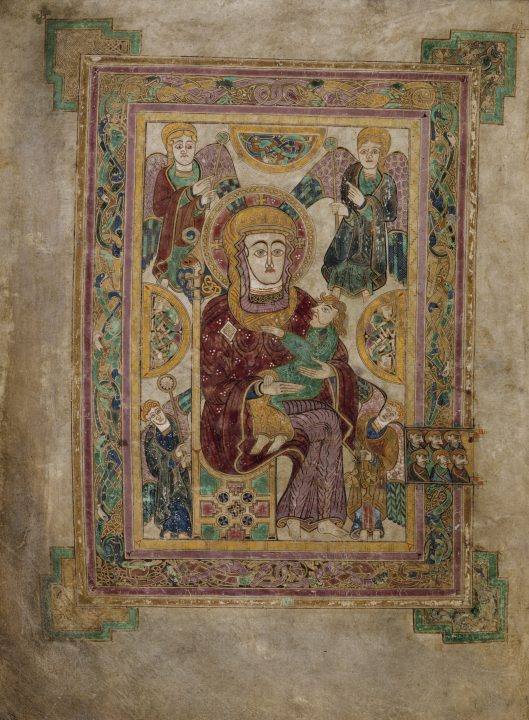
Folios 7v – 8r, Gospel of Matthew
Caoimhe Ní Ghormáin
1 min read • 26 August 2026
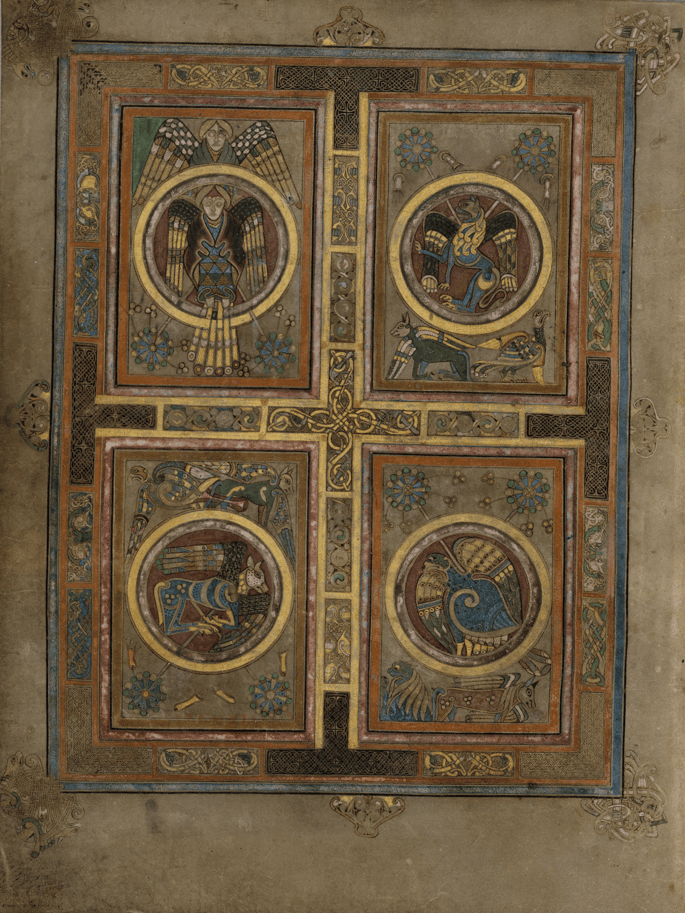
Folio 129v, Book of Kells
St Mark’s Gospel opens with the Evangelists’ symbols: the man (Matthew), lion (Mark), eagle (John), and calf (Luke). These symbols, arranged around a central cross, act as a reminder that together the four gospels tell the story of Jesus Christ, but each has an emphasis on different parts of that story.
This is a page of extraordinary decorative intricacy and symmetry. The four Evangelist symbols are positioned around a vibrant, yellow-edged cross, with interlaced snakes in the centre. Each symbol is encircled in yellow. Blue and yellow flabella (liturgical fans) are placed above and below the evangelist symbols, with yellow attachments which may be bells. The man is accompanied by a winged figure, with one corner of green infill in the top left corner above him, a seemingly unfinished decorative feature. The lion is accompanied by a calf and an eagle; the calf is accompanied by an eagle and another calf; and the eagle by a calf and a lion. This is to highlight unity in the Gospels.
The tail of the eagle, symbol of John, extends outside of the yellow circle, making contact with the calf and the lion (symbols of Mark and Luke) below. The outer frame is decorated with panels containing snakes, peacocks drinking from chalices, and ornate interlace forming crosses. Interlaced lions and peacocks ornament the outer corners of the page.
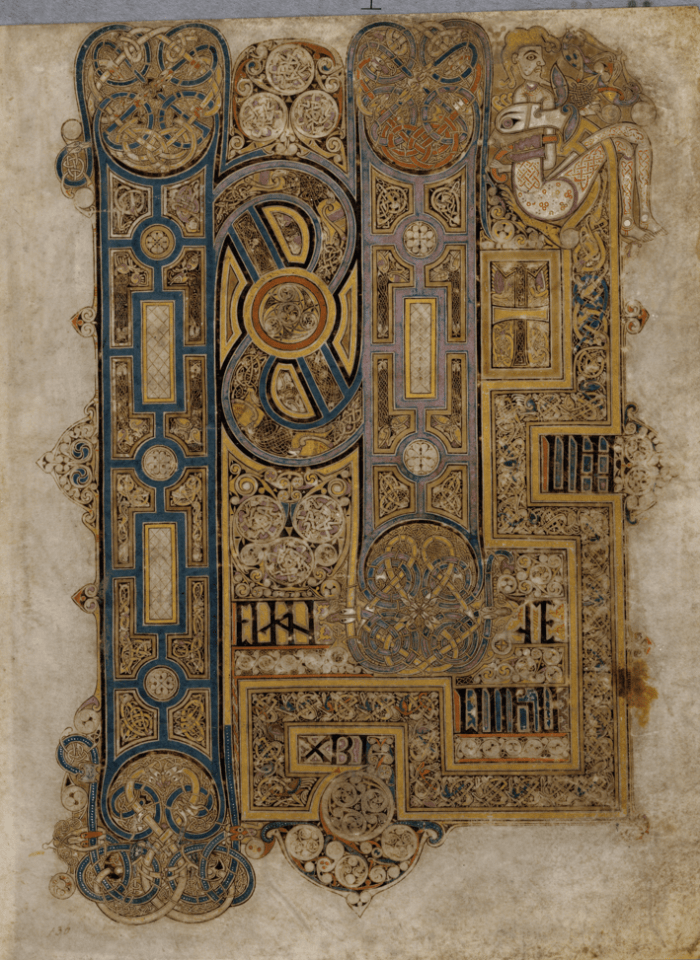
Folio 130r, Book of Kells
Mark’s Gospel opens with an account of Christ’s baptism. The opening words of the Gospel begin on folio 130r ‘Initium euangelii iesu Christi ‘The beginning of the Gospel of Jesus Christ’. The decorative motifs woven into the artwork on the page – peacocks, snakes and a lion– are symbols of Christ’s resurrection and appear frequently throughout the Book of Kells.
The first two letters IN are greatly expanded, with yellow and blue interlacing snakes wound into spirals and knots at the letter ends. Minute figures grasping each other’s arms are seen inside a double set of three circles between the letters. The letters IT are positioned within a yellow rectangle, with winged beasts, perhaps griffins, on either side of the letter I.
The blond-haired man in the upper right-hand corner may represent Christ, dressed in the white garment of baptism embellished with red, the colour of martyrdom. With his right hand he pulls on his beard; with his left hand he grabs the elongated tongue of a lion, which appears to be biting the man’s torso.
Three rectangles, filled with a latticed pattern similar to that of leaded windows found in a church, are outlined in a double border of yellow and blue.
1 min read • 26 August 2026
1 min read • 7 July 2026
1 min read • 12 May 2026